撰文 | 王沛璐 责编 | 周叶斌
约40%儿童癌症存活者在确诊后5-10年内,会面临神经认知障碍的挑战。确诊时年龄低、接受中枢神经系统定向治疗都是已知的危险因素,而存在心肺毒性治疗可能进一步加速神经认知功能的衰退。对于那些在治疗后头10年未出现特定认知领域障碍的儿童,他们在成年后是否仍会比普通人有更高的神经认知障碍风险呢?
近日,圣裘德儿童研究医院 Nicholas S. Phillips 及其研究团队在 JAMA Network Open 发表题为 Late-onset cognitive impairment and modifiable risk factors in adult childhood cancer survivors 的文章,试图回答这个问题。基于儿童癌症存活者研究(CCSS)数据,他们比较了2375名儿童癌症存活者和随机选取的232名幸存者的兄弟姐妹,研究发现存活者发生晚期记忆障碍的风险远高于其兄弟姐妹,而化疗、脑部放疗、吸烟、低学历与低活动水平均与风险升高有关。CCSS是一个对北美31家机构的儿童癌症存活者(确诊时年龄<21岁)进行长期随访的大型队列。研究纳入了完成基线(2003-2004年)和随访(2014-2015年)神经认知问卷的2375存活者,并随机从存活者的兄弟姐妹中选取232名作为对照。研究排除了基线时已存在神经认知功能受损或患有易导致神经认知功能下降的患者。最终纳入存活者的主要癌症类型包括中枢神经系统肿瘤(CNS)、霍奇金淋巴瘤(HL)和急性淋巴细胞白血病(ALL),人群平均随访时间为11.6年。神经认知功能的问卷包括32个条目,涉及四个领域:组织、记忆、任务启动和信息处理速度及情绪控制。根据所有存活者兄弟姐妹(包括另外未被选为对照的1885人)在每个领域得分的总体分布定义结局变量,若分值低于总体分布的10%则视为该领域认知功能障碍。随访数据显示存活者发生认知功能障碍的患病率高于对照,差异最为明显的是记忆功能(图1A),患病率在急性淋巴细胞白血病(未接受脑部放疗14.0%、接受脑部放疗25.8%)、中枢神经系统肿瘤(34.7%)、霍奇金淋巴瘤(16.6%)的幸存者中远高于其兄弟姐妹(7.8%)。在校正年龄和性别后(图1B),接受脑部放疗的急性淋巴细胞白血病存活者在任务执行效率、情绪控制及记忆领域新发障碍的相对风险增高,而中枢神经系统肿瘤的存活者在四个认知领域都有更高的新发障碍风险。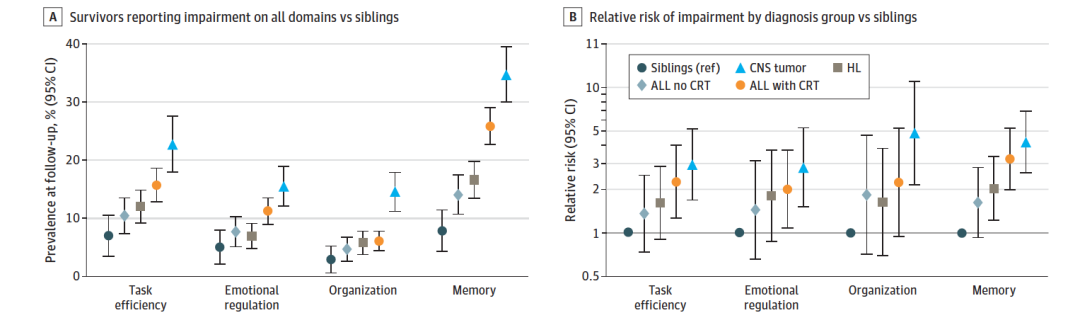
图1. 存活者与对照组发生神经认知障碍的患病率(A)及相对风险(B)既然存活者发生神经认知功能障碍的风险更高,那么背后的病因学机制可能是什么呢?研究者进一步探究了性别、治疗方案、健康状况及健康行为对于新发认知障碍的影响,主要发现归纳于表1。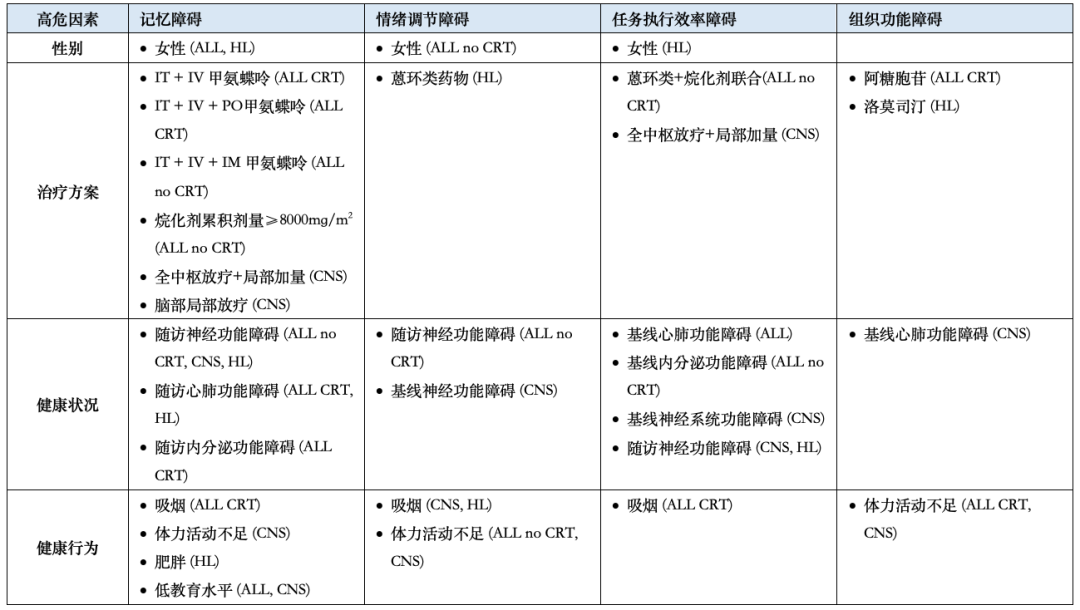
表1. 根据原文主要结果归纳的高危因素:ALL 急性淋巴细胞白血病,CNS 中枢神经系统肿瘤,CRT 颅脑放疗,HL 霍奇金淋巴瘤, IM 肌肉注射, IT 鞘内注射, IV 静脉注射, PO 口服这项研究首次揭示了儿童癌症存活者确诊10年后仍有较高的新发神经认知障碍风险,并指出了生命早期的肿瘤相关治疗、生活方式及健康状况对于成年后认知功能的发展有长远影响。在生命早期使用甲氨蝶呤、中枢神经系统定向治疗等方案,很可能改变了大脑发育的过程,降低了存活者的神经认知储备,从而使得衰老相关进程加快。考虑到存活者在确诊后几十年内慢性疾病风险仍然远高于普通人群,而慢性健康状况是神经认知功能障碍的独立危险因素,对于存活者来说,加强慢病早期筛查和干预显得尤为重要。这项研究也发现吸烟、体力活动、教育等可改变的因素与存活者的神经认知功能有重要关联,进一步支持了存活者在生命早期选择健康的生活方式有望减缓神经认知功能的衰退。但是,这项研究涉及的人群接受肿瘤治疗都在21世纪初,获得的数据无法反映近十多年儿童癌症治疗方案的进步,优化的治疗方案是否可以降低存活者发生晚期神经认知障碍的风险。因此,这方面仍需更多研究。撰文

责编

制作
排版 | 车洁 校对 | uu
延伸阅读
运动可改善儿童肿瘤康复者认知功能
儿童/青少年颅咽管瘤使用质子放疗,能更好保护认知功能
*本文由深圳市拾玉儿童公益基金会“儿童肿瘤前沿”团队编译或约稿,文中图表均源引自文献原文。本文著作权归文章作者所有,欢迎个人转发分享,未经允许禁止转载,作者拥有所有法定权利,违者必究。如需转载,请留言或联系[email protected]。本文旨在分享儿童肿瘤科研前沿成果,不是治疗方案推荐。如需获得疾病治疗方案指导,请前往正规医院就诊。
▼滑动查看更多▼
Importance: Long-term survivors of childhood cancer may be at elevated risk for new neurocognitive impairment and decline as they age into adulthood.Objective: To determine whether aging adult childhood cancer survivors report more new-onset neurocognitive impairments compared with their siblings and to identify risk factors associated with such impairments.Design, setting, and participants: Participants of this cohort study included adult survivors of childhood cancer from the Childhood Cancer Survivor Study and their siblings as a control group. The original cohort included survivors who received a diagnosis between January 1, 1970, and December 31, 1986, for whom longitudinal neurocognitive assessment was available. This study examined the prevalence of new-onset neurocognitive impairment between baseline (23.4 years after diagnosis) and follow-up (35.0 years after diagnosis). The analysis was performed from January 2021 to May 2022.Exposures: Cancer treatment exposures were abstracted from medical records. Chronic health conditions were graded using Common Terminology Criteria for Adverse Events version 4.03.Main outcomes and measures: The primary outcome was new-onset (present at follow-up, but not present at baseline) neurocognitive impairment (defined as a score in the worst 10% of the sibling cohort). Impairment was assessed using the Childhood Cancer Survivor Study Neurocognitive questionnaire. Relative risks (RRs) and 95% CIs were used to estimate associations of neurocognitive impairment with treatment and health behaviors and conditions using generalized linear models.Results: The cohort comprised 2375 survivors (mean [SD] age at evaluation, 31.8 [7.5] years; 1298 women [54.6%]) of childhood cancer, including acute lymphoblastic leukemia (ALL; 1316 participants), central nervous system (CNS) tumors (488 participants), and Hodgkin lymphoma (HL; 571 participants). A total of 232 siblings (mean [SD] age at evaluation, 34.2 [8.4] years; 134 women [57.8%]) were included. Compared with siblings, a higher proportion of survivors with no impairment in memory at baseline had new-onset memory impairment at follow-up: siblings proportion, 7.8% (95% CI, 4.3%-11.4%); ALL survivors treated with chemotherapy only, 14.0% (95% CI, 10.7%-17.4%); ALL survivors treated with cranial radiation (CRT), 25.8% (95% CI, 22.6%-29.0%); CNS tumor survivors, 34.7% (95% CI, 30.0%-39.5%); and HL survivors, 16.6% (95% CI, 13.4%-19.8%). New-onset memory impairment was associated with CRT in CNS tumor survivors (RR, 1.97; 95% CI, 1.33-2.90) and alkylator chemotherapy greater than or equal to 8000 mg/m2 in ALL survivors treated without CRT (RR, 2.80; 95% CI, 1.28-6.12). Neurologic conditions mediated the impact of CRT on new-onset memory impairment in CNS survivors. Smoking, low educational attainment, and low physical activity were associated with elevated risk for new-onset memory impairment.Conclusions and relevance: These findings suggest that adult survivors of childhood cancer are at elevated risk for late-onset memory impairment related to modifiable risk factors identified early in survivorship.DOI: 10.1001/jamanetworkopen.2023.16077
 学术经纬约 6 分钟