对于复发或难治性经典霍奇金淋巴瘤(cHL)患者,系统治疗后采用高剂量化疗(HDCT)和自体造血干细胞移植(HCT)曾被认为是标准治疗方法,低风险患者的5年无进展生存率可达72%。然而,与普通人群相比,采用这种治疗方案的患者晚期死亡风险增加了9.6倍,主要疾病或死亡原因包括继发性恶性肿瘤、器官衰竭、感染、心脏病、肺病和不孕症。因而,寻找可以在保持患者高生存率同时、尽量减少长期毒性影响的治疗策略尤为重要。此前研究显示,采用靶向PD-1的单克隆抗体Nivolumab加靶向CD30的抗体药物偶联物Brentuximab vedotin(BV)、辅以诱导细胞毒性作用的烷化剂Bendamustine强化,在成人cHL和复发/难治性cHL儿童患者中均表现出良好的疗效。而放疗是低风险、复发cHL患者中HDCT/自体HCT巩固治疗的潜在替代方案,基于风险分层采用更小照射野的放疗,有望减少治疗的长期毒性效应。近日,欧洲儿童肿瘤网络(EuroNet)、儿童肿瘤组(Children’s Oncology Group)及企业合作在 JAMA Oncology 上刊登题为 Transplant-Free Approach in Relapsed Hodgkin Lymphoma in Children, Adolescents, and Young Adults: A Nonrandomized Clinical Trial 的文章,介绍一项2期、非随机的单臂研究,纳入了2017年9月至2020年12月期间在美国、加拿大和欧洲的5至30岁低风险cHL患者共28名,旨在评估这些患者是否可以获益于一种替代HDCT加自体HCT的疗法。
具体来说,患者首先接受4个周期的nivolumab加BV诱导治疗;完全代谢缓解(CMR)的患者再接受2个周期的Nivolumab加BV,而反应不佳的患者则接受2个周期的BV加Bendamustine强化治疗;诱导或强化治疗后达到CMR的患者随后接受受累部位放疗(ISRT)的巩固治疗(图1)。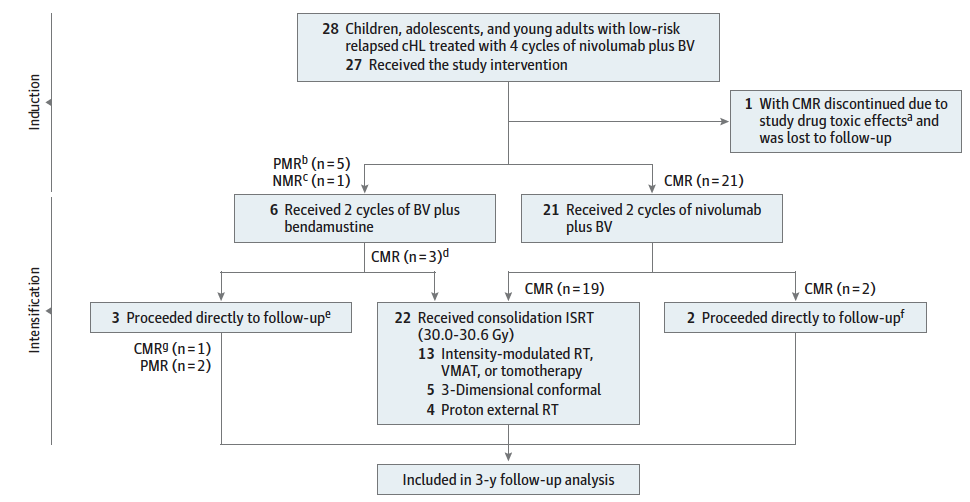
图2显示,在采用ISRT前,有26名患者达到了CMR(总缓解率为100%),完成4周期Nivolumab联合BV治疗后, 23名达到了CMR(总缓解率为96.4%)。中位随访时间为31.9个月, 3年无事件生存率为86.9%(90% CI,69.5-94.7),3年无进展生存率为95.0%(90% CI,76.7-99.0)。大多数患者的肿瘤体积较基线有超过50%的减少。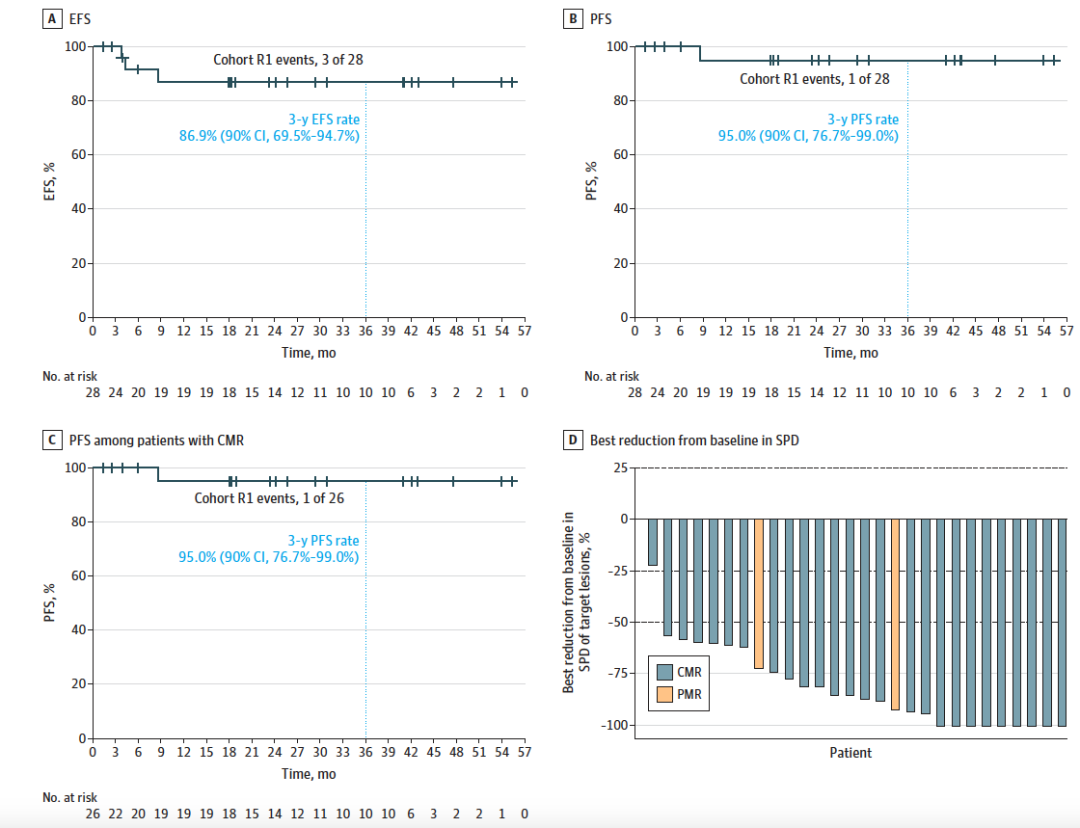
安全性方面(表1),22名患者(79%)在诱导治疗期间出现治疗相关不良事件(TRAE),包括7例3级或4级不良事件(2例贫血、1例中性粒细胞减少及6例免疫介导的不良事件)。在增强治疗阶段,2名患者发生了TRAE,没有患者出现3级或4级TRAE。在巩固治疗阶段,3名患者出现了TRAE,2名患者发生了3级或4级TRAE。总共有2名患者因严重不良事件而终止治疗。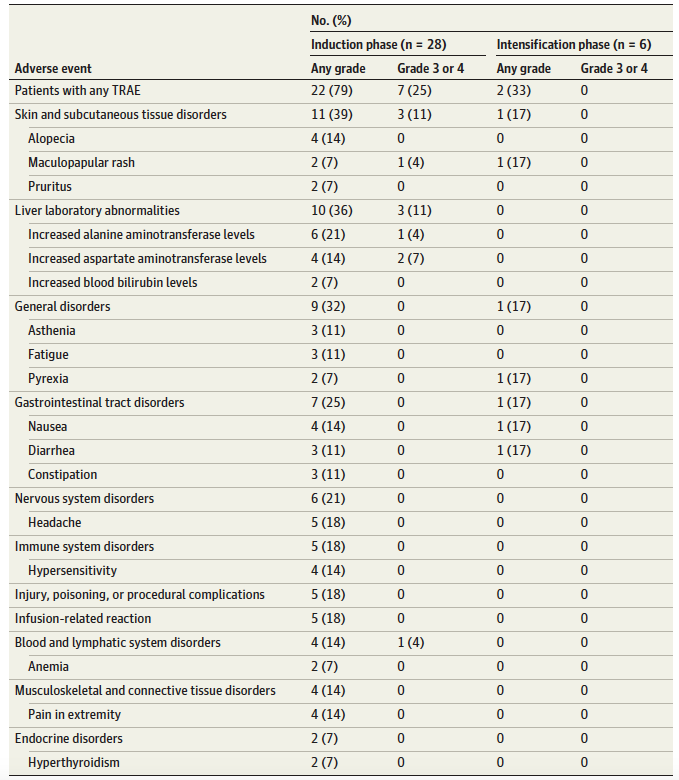
这项基于CheckMate 744的研究,首次在复发或难治性cHL年轻患者中前瞻性地评估了免疫、化疗联合放疗的价值。研究结果显示,在未进行HDCT/自体HCT的情况下,通过联合使用Nivolumab与BV,辅以BV和Bendamustine的强化治疗、并采用较小剂量的放疗巩固,就能达到良好的疗效,有望在保证患者长期生存条件下降低治疗的毒性。但是考虑到本研究为单臂、小样本设计,且随访时间较短,仍需更多证据进一步佐证。撰文

责编

制作
排版 | 车洁 校对 | uu
延伸阅读
Blood | 免疫疗法联合抗体偶联药治疗儿童淋巴瘤:疗效更好毒性更低
*本文由深圳市拾玉儿童公益基金会“儿童肿瘤前沿”团队编译或约稿,文中图表均源引自文献原文。本文著作权归文章作者所有,欢迎个人转发分享,未经允许禁止转载,作者拥有所有法定权利,违者必究。如需转载,请留言或联系[email protected]。本文旨在分享儿童肿瘤科研前沿成果,不是治疗方案推荐。如需获得疾病治疗方案指导,请前往正规医院就诊。
▼滑动查看更多▼
Importance: Retrieval strategies for children, adolescents, and young adults with relapsed classic Hodgkin lymphoma (cHL) aim to maintain efficacy while minimizing long-term toxic effects. Children, adolescents, and young adults with low-risk, relapsed cHL may benefit from replacing high-dose chemotherapy and autologous stem cell transplant with less intensive involved-site radiotherapy (ISRT).Objective: To evaluate a risk-stratified, response-adapted, transplant-free approach for treatment of children, adolescents, and young adults with low-risk relapsed cHL with nivolumab plus brentuximab vedotin (BV) followed by BV plus bendamustine for patients with suboptimal response and ISRT (30.0 to 30.6 Gy).Design, setting, and participants: CheckMate 744 (R1 cohort) was a phase 2, nonrandomized, single-arm study enrolling children, adolescents, and young adults aged 5 to 30 years with low-risk cHL between September 25, 2017, and December 16, 2020, across the US, Canada, and Europe. Data were analyzed from September 2017 to November 2022.Exposures: Patients received 4 cycles of nivolumab plus BV induction; patients with complete metabolic response (CMR) received an additional 2 cycles of nivolumab plus BV while patients with suboptimal response received 2 cycles of BV plus bendamustine intensification. Patients with CMR after induction or intensification received ISRT consolidation.Main outcomes and measures: Prespecified coprimary end points were CMR rate (Lugano 2014 classification) any time before ISRT and 3-year event-free survival (EFS) rate, per blinded independent central review (BICR).Results: Of 28 included patients treated in the low-risk cohort, 18 (64%) were female, and the median (range) age was 17 (6-27) years. At a median (range) follow-up of 31.9 (2.2-55.3) months, CMR per BICR any time before ISRT was 93% (26 of 28; 90% CI, 79.2-98.7; objective response rate [ORR], 100%), and 23 of 28 (82%) achieved CMR per BICR after 4 cycles of nivolumab plus BV (ORR, 96.4%). Kaplan-Meier estimates of EFS and progression-free survival rates at 3 years were 87% (3 of 18; 90% CI, 69.5-94.7) and 95% (1 of 18; 90% CI, 76.7-99.0), respectively. During induction, 22 patients (79%) had treatment-related adverse events, including 7 with grade 3 or 4 adverse events, 2 with anemia, 1 with neutropenia, and 6 with immune-mediated adverse events. Serious adverse events leading to discontinuation occurred in 2 patients.Conclusions and relevance: This nonrandomized clinical trial found that for children, adolescents, and young adults with low-risk, relapsed cHL, a transplant-free, risk-adapted, response-based approach with nivolumab plus BV and ISRT offered high CMR rates and high 3-year EFS rate, with a safety profile consistent with that of each agent used.Trial registration: ClinicalTrials.gov Identifier: NCT02927769.DOI: 10.1001/jamaoncol.2024.5627
 专业点燃希望约 6 分钟