Yuelu Academy Lecture Series on Comparative Classics
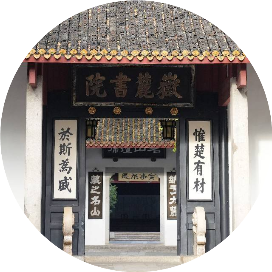 岳麓书院约 6 分钟
Yuelu Academy Lecture Series
on Comparative Classics
— 岳麓书院比较古典学系列讲座 —
Global Classics and Human Futures, Part 1
全球古典学与人类未来·第一季
Speaker
Wiebke DENECKE 魏朴和
Professor of Chinese, Japanese and Korean Literatures & Philosophies
S. C. Fang Chair in Chinese Language and Culture, MIT
Convener
ZHANG Jun 张俊
Professor, Yuelu Academy, HNU
Director, Center for Comparative Religions & Inter-Civilization Dialogue
Coordinator
WANG Di 王笛
Ph.D., Washington University in St. Louis
Postdoctoral Fellow, Yuelu Academy, HNU
1
HISTORY:
How to Rewrite the Historiography of Classical Literatures? The Case of East Asia
历史:如何重写古典文学史?以东亚为例
时 间
18 June(6月18日)
To mobilize the world’s classical traditions for the building of humanity’s future, we need to revise our stories about the origins and development of classical traditions. This lecture argues that the future of Global Classics depends on rethinking literary historiography as a key practice of organizing our knowledge of cultural traditions in deep time and space. It identifies a central limitation in modern approaches—“vernacular triumphalism”—which presents vernacular languages as the natural culmination of literary development and thereby narrows earlier, more multilingual literary ecologies.
Tracing the emergence of modern literary historiography in East Asia in the late nineteenth and early twentieth centuries, the lecture introduces a typology of historiographical modes: xenographic (accounts written by outsiders using external frameworks), heterographic (accounts written about another culture within a shared regional context), and idiographic (self-authored national literary histories). These forms developed alongside new educational systems and global academic models, shaping literary narratives around bounded linguistic and cultural identities.
The lecture argues that while these historiographies remain foundational, they often compress the broader premodern “world of letters (文)”—a transregional, multilingual intellectual ecology—into more limited frameworks. Recent transregional and multilingual approaches begin to address these limits but frequently retain inherited structures.
As a way forward, the lecture proposes “smart historiographies”: flexible, self-reflective approaches that reconnect with earlier literary ecologies while engaging contemporary methods. The lecture will showcase an example of a “smart historiography” of East Asian literatures, soon to be published in Chinese. Building on the shared concepts of grammars, practices, and ecologies developed across the series, it presents historiography as a central tool for reconfiguring how knowledge is organized. Rethinking literary history in this way contributes to a more inclusive and globally connected understanding of humanity’s classical heritage.
2
HUMANS:
How to Build a Global Metaphilosophy of the Self?
人类:如何构建一种全球性的“自我元哲学”?
时 间
22 June(6月22日)
Concept of the self are fundamental to how our societies, governments, and social science research work. The Cartesian self—as rational, autonomous, universal, and dualistic to the body—is widely influential in modern thought, but obscures humanity’s rich repertoire of definitions of the self. This lecture proposes a global metaphilosophy of the self to understand how different cultural worlds have produced distinct forms of selfhood through theorization, reflection, practice, embodied action. Rather than comparing abstract theories, it reconstructs a repertoire of philosophical modes embedded in institutions, social roles, and lived practices.
Four case studies illustrate this approach: the scholar–official in Tang China (Han Yu), the advisor–philosopher in the Roman world (Seneca), the poet–mystic in the Persianate tradition (Rūmī), and the monk–practitioner in medieval Japan (Dōgen). Each articulates a distinct “grammar of the self”: relational and role-based, ethical and reflective, transformative and affective, or embodied and deconstructive. Across these cases, the self is not a fixed substance but something cultivated, performed, and transformed within specific intellectual and institutional ecologies.
The lecture argues that for the urgent project of globalizing the still Western-centric field of Classics, we need to start by globalizing our concepts of the self—through a global “metaphilosophy” of the self that asks: what has the “self” been in different cultures, periods, and places? Such a global metaphilosophy does not simply globalize philosophy by adding new traditions, but reconfigures its methods by asking what philosophy does—how it forms selves across time and space. By recovering these plural modes of self-making, it outlines a shared conceptual vocabulary for thinking about human subjectivity beyond narrow cultural frameworks. Such an approach opens new possibilities for understanding the self in a globally connected world and highlights philosophy as a set of practices for shaping human life.
3
NATURE:
Ecological Awareness and the Grammars of Nature in East Asia, Persia, and Rome
自然:东亚、波斯与罗马的生态意识与“自然语法”
时 间
23 June(6月23日)
Humans always understand themselves within the context of nature and the environment, and understanding this positioning of humans is all the more important in an age where humans are radically changing the environment. Moving from concepts of the self, we focus on notions of nature from different classical traditions in order to understand how people from different cultures are “wired” for distinct forms of what I will call “cognitive empathy” with nature. This lecture develops a comparative framework for understanding how classical literary traditions have encoded distinct “grammars of nature”—structured ways of perceiving, feeling, and relating to the natural world. Rather than treating nature as a universal category, it examines how literary cultures have historically shaped cognitive, emotional, and ethical orientations toward the environment.
Drawing on case studies from Chinese, Japanese, Latin, and Persian traditions—including the Classic of Poetry, Tang poetry, the Kokinshū, Horace’s Odes, and Saʿdī’s Golestān—the lecture shows how nature functions as a medium for social meaning, moral reflection, aesthetic cultivation, and cosmological understanding. These traditions reveal different ways of “learning” nature: as relational environment, symbolic system, ethical resource, and site of human transformation.
Building on the shared vocabulary of “grammars” and “ecologies” introduced in Lecture 2, the talk argues that literary representations of nature are not merely descriptive but formative: they shape habits of perception and patterns of attention. Understanding these historically embedded grammars allows us to reconstruct how human–nature relations were cultivated across classical worlds.
The lecture suggests that recovering these diverse grammars of nature can contribute to rethinking environmental awareness today—not by projecting modern concerns onto the past, but by expanding the repertoire of ways in which humans have imaginatively and ethically engaged with the natural world and expand our cognitive, and also emotional empathy for nature. In this sense, classical literatures offer resources for rearticulating human-nature symbiosis for a sustainable future on this planet.
4
SYMPOSIUM:
Comparative Classics and Sino-Western Cultural Exchange
座谈会:比较古典学与中西文化交流
时 间
22 June(6月22日)